Time to Choose

Featured

The day of my appointment was looming.  I had made a booking with a Home Stylist from John Lewis’ Home Design Service and I had work to do.  I was going to have to convey to my stylist what I saw in my imagination and the look I was aiming to achieve.   

I wasn’t knowledgeable on the subject of interior design nor familiar with the specific vocabulary needed to articulate how I wanted my home to look.  While these deficiencies did not pose an obstacle to using the design service – I was simply invited to send any photographs or images to provide clues about my preferences – I did notice that a desire to learn more about the subject was being awakened.  I wanted to know more about the history and development of design movements. 

The internet can be a wonderful resource for research and I began reading a series of online articles – and blogs, of course!  I searched for books on these themes and found some very helpful, inexpensive books and set about ordering them.  I realised that my understanding of “Art Deco”, “English Country House Style” and the “Arts and Crafts” movement was a little foggy to say the least.  

To illustrate, when I had first started to think about the style I would choose for my home I thought the obvious choice would be Art Deco.  I’d grown increasingly drawn to elements of this design style over recent years and, given that this movement was at its peak in the nineteen twenties and thirties, it would be perfectly in keeping with the style of my property wouldn’t it?  Well, no, not necessarily.

Although my house had been built in the middle nineteen thirties, very few of its features could be associated with Art Deco style.  Rather, the property possessed the features of a very specific type of house built in England in the 1930s – the suburban semi-detached.  The mock-Tudor elements, the red brick construction, the harking back to design styles from previous eras were, if anything, more in tune with the Arts and Crafts movement of the late nineteenth century.   I learnt an important fact – that more than one style of art, design and architecture can exist in one time period.   

Two books in particular were very helpful in identifying the differences between what is now termed “Art Deco” architecture and the typical English suburban housing style of the nineteens thirties.  Both written by Trevor Yorke, the books “The 1930s House Explained” and “Art Deco House Styles” may be small in size but they are packed with information and illustrations identifying the characteristics of these two design styles.
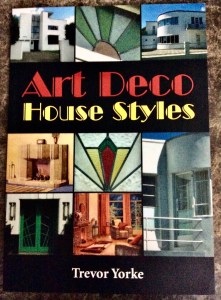
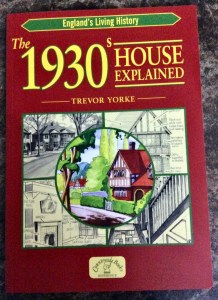
In forthcoming posts, I’ll review the books and highlight points which have proved, in my own case, to be helpful.

( For further information about these books, visit: http://www.countrysidebooks.co.uk )

A Question of Style

The fog was beginning to clear when it came to finding companies to carry out the renovation work.  Over recent years, I’d come to trust local tradespeople to repair and upgrade my apartment – gas fitters, plumbers, painters and decorators, for example.  Of course, I could turn to them to carry out work for me but what I hadn’t utilised previously was their wealth of knowledge of other locally based, skilled workers.  They knew electricians, builders and joiners they’d worked with on a wide variety of projects and they were confident in making recommendations.  The answer to the question of who would do my work was closer to home than I’d realised!

The next stage involved on-site meetings with a succession of tradespeople to find out who seemed best suited to the brief and to begin to gather rough estimates of costs.  At this point, I had tried to focus on practical tasks such as plumbing and wiring and I’d avoided becoming side-tracked with more superficial questions.  Trivialities such as the wallpaper and furniture I’d like could not possibly be considered at this stage!  Or so I thought.

While discussing possible ideas for lighting and fitted shelving, the electrician and joiner I spoke with wanted to know more about my intended decor styles.  They needed to know that any fittings they would install would be appropriate and in keeping with the intended “look” which was to be achieved.

And that was the moment it all became exciting!  I began to understand that design, decor, styling – whatever we wish to call it – was absolutely integral to the planning and execution of the renovations.  Rather than dismissing thoughts of decor, I needed to know from the outset the style I was aiming to achieve.

This led to a further dilemma.  My natural inclination seemed to favour what I would term “English Country House” styling yet my thoughts kept gravitating back to the concept that homes look best when they are decorated in a style in keeping with the era of the building.  This was a nineteen thirties house, so did that mean I’d need to replicate the interior of an English pre-war dwelling and, effectively, live in a museum? 

I’d also noted – in more recent years – how much I was being drawn to Art Deco shapes and forms and it struck me that it would not be inappropriate to include some features evocative of that style.   This was no Miami Beach Art Deco building however, this was a modest structure built with the very particular features with which suburban housing of 1930s England is associated.  Would Art Deco features look contrived, too theatrical and out of place?  

Would I be restricted by a rigid formula of what an English “thirties” home should or should not contain?  Would I be allowed to blend in a few touches harking back to my love of the English Country House style?   What about my interest in the Arts and Crafts movement – could William Morris put in an appearance anywhere?  And how could I forget Charles Rennie Mackintosh?  Those stylised roses for which Mackintosh is renowned could be squeezed in somewhere, surely?

I realised that there was no one theme which would fulfil all of the decor features I’d love to have in my home.  However, I also realised that choosing an “eclectic” design ran the risk of ending up with a confused, cluttered mess.  I wondered if it could be possible to blend interior design styles in a restrained, controlled way and to produce an harmonious and balanced result.  

The Goring Hotel, London

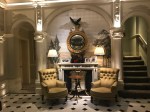
One sunny, early Spring day, I was enjoying a pre-lunch drink in the lounge of The Goring Hotel in London.  (Stay with me, this is actually relevant!)  For me, this hotel demonstrates English Country House Style (with a very light touch of eccentricity). Relaxing in the lounge, I took in the features around me and as my gaze reached ceiling level I felt a distinct change in atmosphere.  As I stared at the golden-bronze ceiling with its warm glow and muted splendour,  it seemed I was no longer sitting in a grand country home. I’d been transported to Paris at the end of the nineteenth century and I might well have had Toulouse Lautrec sitting next to me!  Whether this was the intended effect of the decor, I can’t say, but that was most definitely my response to it.  I was looking at a seamless blending of styles – of English classic styling set next to a feature which would have looked at ease in a fin-de-siècle Parisian café. 

The Goring Hotel Lobby

So it can be done!  It is possible to mix styles and for the end result to look harmonious and really rather beautiful.  It struck me however, that you’d really have to know what you were doing to pull off such an interior design “mash-up” and get it right.  Unsure I had the ability to achieve such an objective, another question was raised:  who will help me to blend the styling themes I love yet achieve an harmonious integration?

A.P.

31 May 2021

Photo Credits:

The Goring Hotel Exterior: Photo 58984840 © Slawek Kozakiewicz | Dreamstime.com

The Goring Hotel Lift Lobby: A.P.